

Light My Fire: Ranking Flammable Liquids
US DOT and OSHA each impose regulations that apply to flammable and/or combustible liquids. But the two agencies "regulate" these liquids differently, and for different reasons. Each views the hazards and risks of flammable liquids through the lens of a specialized mandate from Congress—OSHA to protect workers in the workplace.and US DOT to ensure safe transportation of hazardous materials (among other goals).
In the business of moving goods from one place to another, these two mandates overlap. You can see how OSHA and DOT categorize flammable liquids below. When you recognize the similarities and consider each agency’s regulatory goals, you can limit confusion about what rules apply to your activities or materials at any moment.
OSHA and US DOT both use flash point and boiling point to “rank” regulated flammable liquids.
Flash point is the lowest temperature at which an ignition source near the liquid “flashes” back and ignites the vapors. You can see details about how a flash point test works here.
Boiling point is what it sounds like; the temperature at which a liquid starts boiling. To be more specific, boiling point is the temperature at which the vapor pressure of the liquid equals the atmospheric pressure—in other words, when the liquid starts to turn to vapor of fumes.*
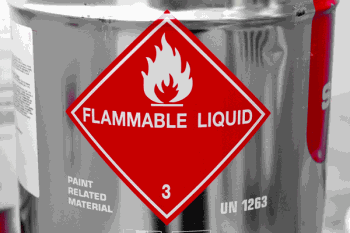
OSHA Hazard Communication for Flammable Liquids
OSHA groups flammable liquids into four categories, with criteria laid out in Appendix B to the Hazard Communication Standard or HCS (29 CFR 1910.1200).
The HCS exists to make sure that employees are informed and trained about the hazards of chemicals in their workplace. OSHA's categories for flammable liquids make employers and workers aware of the severity of the hazard, so that they can take appropriate steps to limit the risk of handling and working around the material.
Table B.6.1 - Criteria for Flammable Liquids (29 CFR 1910.1200, Appendix B)
| Category | Criteria |
|
1
|
Flash point < 23°C (73.4°F), Initial boiling point ≤ 35°C (95°F). |
|
2
|
Flash point < 23°C (73.4°F), Initial boiling point > 35°C (95°F). |
| 3 |
Flash point ≥ 23°C (73.4°F) and ≤ 60°C (140°F). |
| 4 |
Flash point > 60°C (140°F) and ≤ 93°C (200°F) |
* The ASTM test method for boiling point that OSHA approves in the HCS utilizes a distillation unit to slowly heat a liquid. The initial boiling point is the temperature at which the first drop of condensate is obtained rising off of the liquid.
US DOT Hazardous Materials Regulations for Flammable Liquids
While OSHA is concerned with flammable liquids in the workplace, US DOT's mandate—through its sub-agency the Pipeline and Hazardous Materials Safety Administration (PHMSA)—kicks in when those materials enter the cycle of transportation. The categories of flammable liquids in the Hazardous Materials Regulations (HMR), called "packing groups," are used by shippers to determine the type and strength of packaging needed to contain the material.
When a material has more than one hazard, the packing group ("PG" for short) sometimes contributes to the material's "ranking" against other hazmat when determining precedence of hazard.
DOT/PHMSA Packing Group Assignments for Flammable Liquids (49 CFR 173.121)
| Category | Criteria |
| PG I |
Initial boiling point ≤ 35°C (95°F); |
|
PG II
|
Flash point < 23°C (73.4°F) Initial boiling point > 35°C (95°F) |
|
PG III
|
Flash point ≥ 23°C, ≤ 60°C (≥ 73°F, ≤ 140°F) Initial boiling point > 35°C (95°F) |
| "Combustible" | Flash point ≥ 60°C, ≤ 93°C (≥ 140°F, ≤ 199.4°F) |
The criteria for categories 1 through 3 are essentially identical in OSHA and DOT. regulations. DOT rounds 93° Celsius to "200°F" in its fourth category, while OSHA uses the more exact 199.4°F. That fourth category, which OSHA considers "Category 4" can be classed as "combustible liquids" in transportation (under certain conditions), qualifying for some reliefs from the HMR. (More: 3 Combustibles Shipping Examples).
Upcoming DOT Hazmat Training in Dallas, Houston, Chicago, and...
Join Lion for engaging, lively in-person training and develop the expertise you need to classify and name hazardous materials, package hazmat, mark and label packages, fill out shipping papers, and comply with DOT security plan and security training requirements for hazmat employees.
Hazmat Ground Shipper Certification (DOT) Workshop
| Dallas, TX | March 2–3 |
| Houston, TX | March 20–21 |
| Chicago, IL | April 20–21 |
| Cincinnati, OH | April 26–27 |
| St. Louis, MO | May 3–4 |
| Ontario, CA | May 10–11 |
| San Diego, CA | May 17–18 |
The 2023 Training Schedule of hazmat shipper workshops and webinars is available now.
Find a Post
Recent Posts
Compliance Archives

Download Our Latest Whitepaper
In most cases, injuries that occur at work are work-related and must be recorded to maintain compliance with OSHA regulations. This report shows you the 9 types of injuries you don’t record.

By submitting your phone number, you agree to receive recurring marketing and training text messages. Consent to receive text messages is not required for any purchases. Text STOP at any time to cancel. Message and data rates may apply. View our Terms & Conditions and Privacy Policy.