

Chemical Manufacturer Settles for $1M: RCRA Errors Explained
The US EPA came to an agreement with a chemical manufacturer to resolve alleged noncompliance at its neoprene manufacturing facility in LaPlace, Louisiana, which suspended operations in 2025. As part of the agreement, the manufacturer will pay a civil penalty of $996,703.35.
All violations or claims discussed below are alleged only unless we say otherwise, and we withhold the names of organizations and individuals to protect their privacy.

Investigation and RCRA Hazardous Waste Violations
The EPA and the Louisiana Department of Environmental Quality (LDEQ) have conducted several inspections of the facility in recent years. The EPA conducted an inspection and sampling investigation in May 2023, a sampling inspection in May 2022, and, together with the LDEQ, a RCRA compliance inspection in April 2022.
Find a summary of alleged violations detailed in the agreement below.
Failure to Make Hazardous Waste Determinations
Solid waste generators are required to make hazardous waste determinations at the point of generation, including a determination about whether the waste exhibits one or more hazardous characteristics.
According to the EPA, the manufacturer failed to make proper hazardous waste determinations for three solid wastes that, upon testing, were discovered to be hazardous waste. All three of these solid wastes exhibited the ignitable characteristic. One exhibited the reactivity characteristic.
Failure to Comply with Land Disposal Restrictions (LDR)
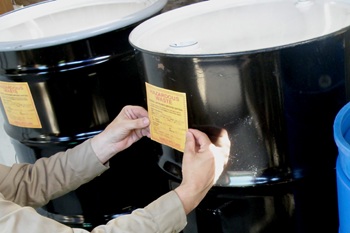
Generators are required determine if hazardous waste needs to be treated before it can be land disposed. According to the settlement, the manufacturer failed to make this determination.
It is common for generators that fail to make hazardous waste determinations to also make this mistake. If you fail to determine a solid waste is a hazardous waste, it is unlikely you will treat it with the respect it deserves.
Hazardous Waste Treatment and Storage Without a Permit
Under the RCRA regulations, sites need a permit to treat and store hazardous waste. That permit authorizes where and how hazardous waste is treated and stored.
The manufacturer allegedly added liquid to hazardous waste in a pit to reduce the potential for fires and explosions. That action changed the waste to become less hazardous, which constitutes “treatment” as defined in the hazardous waste regulations. No permit authorized this treatment.
The EPA also determined that the retention of that waste for a period of time in said pit covered with liquid brine constitutes “storage” as defined in the hazardous waste regulations.
The manufacturer steamed the other two solid wastes for two hours at the point of generation in order to “deactivate” it and reduce ignition potential. The EPA determined this action constitutes “treatment” as defined in the hazardous waste regulations. No permit authorized this treatment.
Container Violations
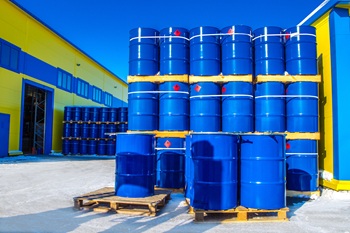
Among the observed hazardous waste container violations, the EPA noted the facility failed to comply with permit container requirements including failure to label hazardous waste drums with a start accumulation date, stored hazardous waste without a permit, and failed to comply with container inspection and recordkeeping requirements.
Failure to Comply with Permit Facility Design and Operation Requirements
The Agency found that, in violation of the hazardous waste regulations, the manufacturer did not maintain and operate the Facility to minimize the possibility of release of hazardous waste or hazardous waste constituents to the air that could threaten human health or the environment.
RCRA Hazardous Waste Management Training for Generators
Lion offers a range of RCRA training courses for industry professionals at every stage of their career. For managers with overall responsibility for RCRA compliance, we recommend comprehensive RCRA Hazardous Waste Management training.
Browse all online and in-person RCRA training options at Lion.com/RCRA.
Tags: EPA Enforcement, hazardous waste management, RCRA, RCRA compliance
Find a Post
Recent Posts
Compliance Archives

Download Our Latest Whitepaper
Just starting out with shipping lithium batteries? The four fundamental concepts in this guide are the place to start.

By submitting your phone number, you agree to receive recurring marketing and training text messages. Consent to receive text messages is not required for any purchases. Text STOP at any time to cancel. Message and data rates may apply. View our Terms & Conditions and Privacy Policy.