

Lithium and Sodium Battery Updates in the 2027 IATA DGR
The International Air Transport Association (IATA) has published a list of significant changes and amendments to the 68th Edition of its Dangerous Goods Regulations (DGR), the manual used to ship and transport hazardous materials by aircraft within the US and internationally.
This article covers changes that may impact your lithium/sodium battery shipments. Compliance with the revised requirements in the 68th Edition DGR is mandatory as of January 1, 2027.
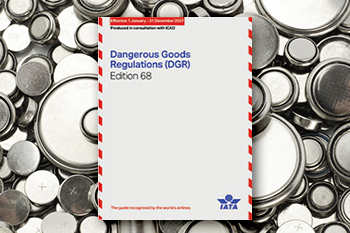
Order the 68th Ed. IATA Dangerous Goods Regulations.
Updates for Lithium/Sodium Battery Shippers
The battery mark
The 68th IATA DGR clarifies that, though the battery mark should no longer contain a phone number and shippers should use the current version of the battery mark, use of that phased-out mark should not form the sole basis for rejection.
If a shipment requires a battery mark and other hazard labels, the battery mark is to be placed on the same surface as the other hazard labels.
Packing instructions for sodium-ion batteries
IATA amended more than two dozen packing instructions, many relating to the addition of sodium-ion batteries and the changed text around prototype batteries.
For Section II packages using Packing Instructions 967, 970 and 978 containing no more than 4 cells or 2 batteries, any button cells in the equipment do not count towards the 4-cell/2-battery limit.
Classification
The addition of Paragraph (h) to §3.9.2.6.1 applies to the classification of hybrid batteries composed of lithium-ion and sodium-ion cells.
It added two new UN numbers to the list of dangerous goods:
- UN 3563 Lithium metal batteries installed in cargo transport unit
- UN 3564 Sodium ion batteries installed in cargo transport unit
Special Provisions (SP)
IATA:
- Amended A107, A185, A213, A225 and A228 to include additional references to lithium/sodium batteries.
- Amended A214 to contain additional guidance material on the classification, and differences, between battery-powered vehicles and battery-powered equipment.
- Added SP A235, which relates to the classification of hybrid batteries, containing both sodium-ion and lithium cells or batteries.
Hazmat Training to Ship by Air
Lion’s Hazmat Air Shipper Certification (IATA) training provides additional hazmat training to prepare and offer hazardous materials/dangerous goods air shipments. The training covers how to navigate and apply the unique IATA DGR to ship hazmat/dangerous goods by passenger and/or cargo aircraft.
Available as a workshop, webinar, or online course.
Tags: dangerous goods, hazardous materials, hazmat shipping, IATA, IATA DGR
Find a Post
Recent Posts
Compliance Archives

Download Our Latest Whitepaper
Ace hazmat inspections. Protect personnel. Defend against civil and criminal penalties. How? See the self-audit "best practices" for hazardous materials shippers.

By submitting your phone number, you agree to receive recurring marketing and training text messages. Consent to receive text messages is not required for any purchases. Text STOP at any time to cancel. Message and data rates may apply. View our Terms & Conditions and Privacy Policy.