

HAZWOPER Training: A Complete Guide for Emergency Response & Site Cleanup
The Hazardous Waste Operations and Emergency Response (HAZWOPER) Standard is an OSHA workplace health and safety standard found at 29 CFR Part 1910.120. HAZWOPER exists to protect employees in work environments that pose an elevated risk of exposure to “hazardous substances.”
This guide clarifies the Federal OSHA training requirements and who needs HAZWOPER training, and answers common questions about relevant regulations.
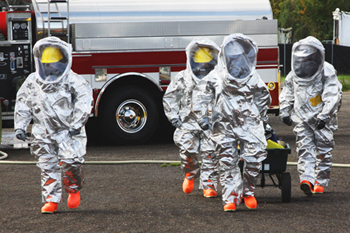
What is HAZWOPER Training?
HAZWOPER training teaches emergency responders and contaminated site workers to comply with the OSHA HAZWOPER Standard and help satisfy initial and annual refresher training requirements.
How Often Is HAZWOPER Training Required?
OSHA requires annual HAZWOPER refresher training for covered employees, including clean-up site workers and emergency response personnel.
Who Needs HAZWOPER Training?
Two activities typically covered by HAZWOPER are contaminated site cleanup and emergency response [29 CFR 1910.120(e) and 29 CFR 1910.120(q)].
Who Needs Site Cleanup HAZWOPER Training?
Personnel who work at “uncontrolled hazardous waste sites.” This includes managers, supervisors, and any employees who may be exposed to hazardous substances health hazards, or safety hazards during cleanup activities, including those with non-cleanup duties, like utility workers.
Common job responsibilities that require HAZWOPER training include assessing the site, operating equipment on site, excavating drums and other containers, monitoring hazardous substances, taking environmental samples, handling drums of hazardous waste, supervising personnel, and more. This HAZWOPER infographic illustrates the types of site cleanup personnel who need HAZWOPER training.
Who Needs Emergency Response HAZWOPER Training?
Facility emergency response personnel. OSHA splits this up category based on each employee’s responsibility during an emergency release. This HAZWOPER infographic illustrates the “levels” of emergency responders and what HAZWOPER training is required for each employee.
HAZWOPER “emergency response” covers activities like sounding alarms, covering drains and vents, actively approaching the area of a release to plug, patch, or otherwise stop it, and overseeing the facility’s response to emergency releases.
What Is an Emergency Under HAZWOPER?
OSHA does not define an "emergency" based on any amount of hazardous substance(s) released or spilled. Depending on the specific substance involved and the circumstances of the incident, even a "small" spill or accident may warrant emergency response.
Some situations that are likely to be emergencies requiring some level of coordinated emergency response effort, according to OSHA, include:
- High concentrations of toxic substances,
- Immediately Dangerous to Life or Health (IDLH) environments,
- Situations that could result in death or injury,
- Oxygen deficient atmospheres,
- Conditions that pose a fire or explosion hazard,
- Situations that required evacuation of the areas, and
- Situations that require immediate attention to protect employees in the area.
[OSHA Standard Interpretation—Emergency situations that fall under HAZWOPER. November 9, 1991.]
What Is Not an Emergency?
The definition of emergency response found at 1910.120(a)(3) includes two scenarios in which a response is not an emergency response:
- "Responses to incidental releases of hazardous substances where the substance can be absorbed, neutralized, or otherwise controlled at the time of the release by employees in the immediate area, or by maintenance personnel are not considered to be emergency responses within the scope of this standard."
- "Responses to releases of hazardous substances where there is no potential safety or health hazard (i.e., fire, explosion, or chemical exposure) are not considered to be emergency responses."
What Is a Contaminated Site Under HAZWOPER?
The HAZWOPER Standard applies to cleanup of hazardous substances at locations specifically designated as "uncontrolled hazardous waste sites." These include government-priority cleanup sites, RCRA corrective actions, and voluntary cleanup.
Govern-priority Cleanup Sites
Cleanup sites covered under the HAZWOPER Standard include:
- Sites on EPA’s National Priority Site List or NPL (i.e., Superfund Sites),
- Sites recommended for the NPL,
- Sites on State priority lists, and
- Sites under investigation for potential contamination.
RCRA Corrective Action
Facilities that store, treat, and dispose of hazardous waste in the United States must comply with the regulations that implement the Resource Conservation and Recovery Act of 1976 (RCRA).
The law, as amended, authorizes US EPA and State agencies to order the investigation and cleanup of any contamination as part of the permitting process. Sites can also enter EPA's Hazardous Waste Cleanup Program following a release of hazardous waste or hazardous constituents.
Voluntary Cleanup
The HAZWOPER Standard applies to voluntary cleanup efforts at any site recognized by a Federal, state, local, or other governmental body as an “uncontrolled hazardous waste site.”
If unsure about the applicability of HAZWOPER to a specific voluntary cleanup activity, the owner of the site or the cleanup organizers should consult with relevant agencies to get confirmation.
What Is a “Hazardous Substance” Under HAZWOPER?
OSHA developed the HAZWOPER Standard to protect emergency responders, site cleanup workers, and others who may be exposed to "hazardous substances." In the HAZWOPER regulations, OSHA defines "hazardous substances" to include four categories.
CERCLA Hazardous Substances
The Comprehensive Environmental Response, Compensation, and Liability Act (CERCLA) authorizes US EPA to maintain a list of substances that can damage the environment if released. The list of CERCLA hazardous substances includes hundreds of substances, from acetone and ammonia to xylene and zinc.
DOT Hazardous Materials
The US Department of Transportation (DOT) defines a “hazardous material” as any substance or material that meets one or more of the criteria of a Hazard Class or Division described in 49 CFR 173, or any material that does not meet those criteria but DOT deems a hazardous material (e.g., Class 9).
RCRA Hazardous Wastes
Under the Resource Conservation and Recovery Act (RCRA), a hazardous waste is a waste that either exhibits one or more hazardous waste characteristics (ignitability, corrosivity, reactivity, or toxicity), or is described on one of the lists of hazardous wastes in the RCRA regulations (F, K, P, & U).
“Biological agents”
Biological agents and other disease-causing agents "...which after release into the environment and upon exposure, ingestion, inhalation, or assimilation into any person...will or may reasonably be anticipated to cause death, disease, behavioral abnormalities, cancer, genetic mutation, physiological malfunctions, or physical deformation..."
Online HAZWOPER Training
Lion delivers online HAZWOPER training for two groups of employees who work with hazardous substances: Emergency responders and site workers at uncontrolled hazardous waste sites (e.g., Superfund sites).
Browse online HAZWOPER training course at Lion.com/HAZWOPER.
Find a Post
Recent Posts
Compliance Archives

Download Our Latest Whitepaper
Decrease spill, release, and injury risk and increase savings with these "source reduction" strategies to prevent unused chemicals from becoming regulated as hazardous waste.

By submitting your phone number, you agree to receive recurring marketing and training text messages. Consent to receive text messages is not required for any purchases. Text STOP at any time to cancel. Message and data rates may apply. View our Terms & Conditions and Privacy Policy.