

Top 20 Most Shipped Hazardous Materials in the US
We discuss shipping and transporting hazardous materials frequently on this blog: But what do we really mean when we say hazardous materials?
We’ve covered the 9 classes and divisions of hazmat and the classification criteria for explosives, gases under pressure, flammable liquids, and so on. In this article, we get more specific.
Below is a list of 20 of the most commonly transported hazardous materials in the United States, divided into five major categories. To be clear: These are not official categories of hazardous materials. These 5 categories were assembled by reviewing the US Census Commodity Flow Survey (CFS) data set for 2022 (made available in June 2025).
Fuels
...as Class 3 Flammable or Combustible Liquids
If you drive on highways anywhere in the United States, you’ve almost certainly seen one of these materials being transported in the wild.
When transported in the United States, fuels and petroleum products are commonly regulated as Class 3 flammable or combustible liquids, like gasoline (UN1203) and jet fuel (UN1863).
| UN ID # | Name, Hazard Class/Division | Amount transported (2022) |
| UN1203 | Gasoline, 3 | ~885 million tons |
| UN1993 | Flammable liquids, n.o.s., 3 | ~500 million tons |
| UN1863 | Fuel, aviation, turbine engine, 3 | ~95 million tons |
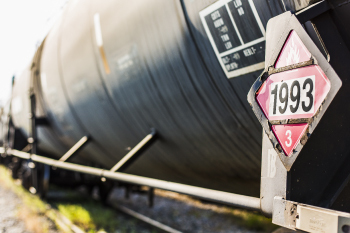
...as Division 2.1 flammable gases
When shipped under pressure, fuels may be transported as Division 2.1 flammable gases. Examples of fuels shipped as Division 2.1 gases include propane (UN1978), liquefied petroleum gas or LPG (UN1075), and methane or “natural gas” (UN1971).
| UN ID # | Name, Hazard Class/Division | Amount transported (2022) |
| UN1075 | Petroleum gases, liquefied, 2.1 | ~81 million tons |
| UN1978 | Propane, 2.1 | ~28 million tons |
| UN1971 | Methane, compressed, 2.1 | ~8 million tons |
Cryogenic/Refrigerated Liquids
Cryogenic liquids are shipped cold—very cold. The exact regulatory definition can be found in the Hazardous Materials Regulations or HMR at 49 CFR 173.115(g).
Liquid nitrogen is used to preserve medical samples, cool equipment and electronics, and flash-freeze food. Liquid oxygen is crucial in hospitals and healthcare facilities, it’s used in welding and to make steel, and even as rocket fuel. And we use liquid carbon dioxide for refrigeration and to add carbonation to drinks.
| UN ID # | Name, Hazard Class/Division | Amount transported (2022) |
| UN1977 | Nitrogen, refrigerated liquid, 2.2 | ~47 million tons |
| UN1073 | Oxygen, refrigerated liquid, 2.2 | ~25 million tons |
| UN2187 | Carbon dioxide, refrigerated liquid, 2.2 | ~10 million tons |
The same gases can be shipped under pressure, as compressed gases. Those shipments are identified by different UN numbers and proper shipping names, for example:
| UN ID # | Name, Hazard Class/Division | Amount transported (2022) |
| UN1066 | Nitrogen, compressed, 2.2 | ~6 million tons |
| UN1072 | Oxygen, compressed, 2.2 (5.1) | ~7 million tons |
Alcohols
Alcohols regulated as hazardous materials in transportation include denatured alcohol, isopropyl alcohol or IPA, ethanol, and methanol. These substances are widely used, as solvents, for cleaning and degreasing, as antiseptics, as preservatives, as fuel, or as an ingredient to manufacture other common chemicals (e.g., formaldehyde).
| UN ID # | Name, Hazard Class/Division | Amount transported (2022) |
| UN1987 | Alcohols, n.o.s., incl. denatured alcohol, 3 | ~36 million tons |
| UN1170 | Ethyl alcohol, 3 | ~34 million tons |
| UN1219 | Isopropyl alcohol, 3 (a.k.a. Isopropanol) | ~3 million tons |
Asphalt/Road Tar
Road tar and asphalt are typically shipped at very high temperatures, in a liquefied state, which prevents them from hardening during transportation. Often, this makes paving materials Class 3 flammable liquids during transportation.
| UN ID # | Name, Hazard Class/Division | Amount transported (2022) |
| UN/NA1999 | Tars, liquid, 3 or Asphalt, 3 (US only) | ~53 million tons |
| UN ID # | Name, Hazard Class/Division | Amount transported (2022) |
| UN3257 | Elevated temperature material, n.o.s., 9 | ~25 million tons |
Corrosive Acids and Bases
Materials that can damage or destroy skin tissue or metal are typically regulated as class 8 corrosive hazardous materials in transportation, including many common acids and bases. These chemicals are prized in many industries due to their versatility.
Sulfuric acid (UN1830) is a prime example: It's used to make fertilizers, fuels, batteries, cleaning products, cosmetics, drain cleaners, paints and dyes, pulp and paper, pharmaceuticals, and many other products, and it’s used to remove rust from steel and copper, and in water treatment.
| UN ID # | Name, Hazard Class/Division | Amount transported (2022) |
| UN1284 | Sodium hydroxide solution, 8 | ~26 million tons |
| UN1830 | Sulfuric acid, 8 | ~20 million tons |
| UN1791 | Hypochlorite solutions, 8 | ~15 million tons |
| UN1789 | Hydrochloric acid, 8 | ~8 million tons |
Other corrosives regulated as hazmat include hydrochloric acid and sodium hydroxide solution—which you may know as caustic soda or lye (and may remember from the movie Fight Club).
See the data here: US Census Commodity Flow Survey (CFS) data set for 2022
Find a Post
Recent Posts
Compliance Archives

Download Our Latest Whitepaper
Knowing why TSDFs reject loads of hazardous waste—and the exact steps to follow if it happens—can reduce your anxiety and uncertainty about rejection.

By submitting your phone number, you agree to receive recurring marketing and training text messages. Consent to receive text messages is not required for any purchases. Text STOP at any time to cancel. Message and data rates may apply. View our Terms & Conditions and Privacy Policy.